
Preventing “thinkslop”: a framework for intelligent AI delegation
As generative AI takes on more cognitive work, a new organisational risk is emerging: "thinkslop". The challenge is exercising judgment over which tasks to delegate and which human capabilities must be preserved.
To navigate this, Dr Fendi Tsim and A. Gutoreva co-developed the SCAN framework: a practical decision-making model designed to facilitate effective task allocation with GenAI.
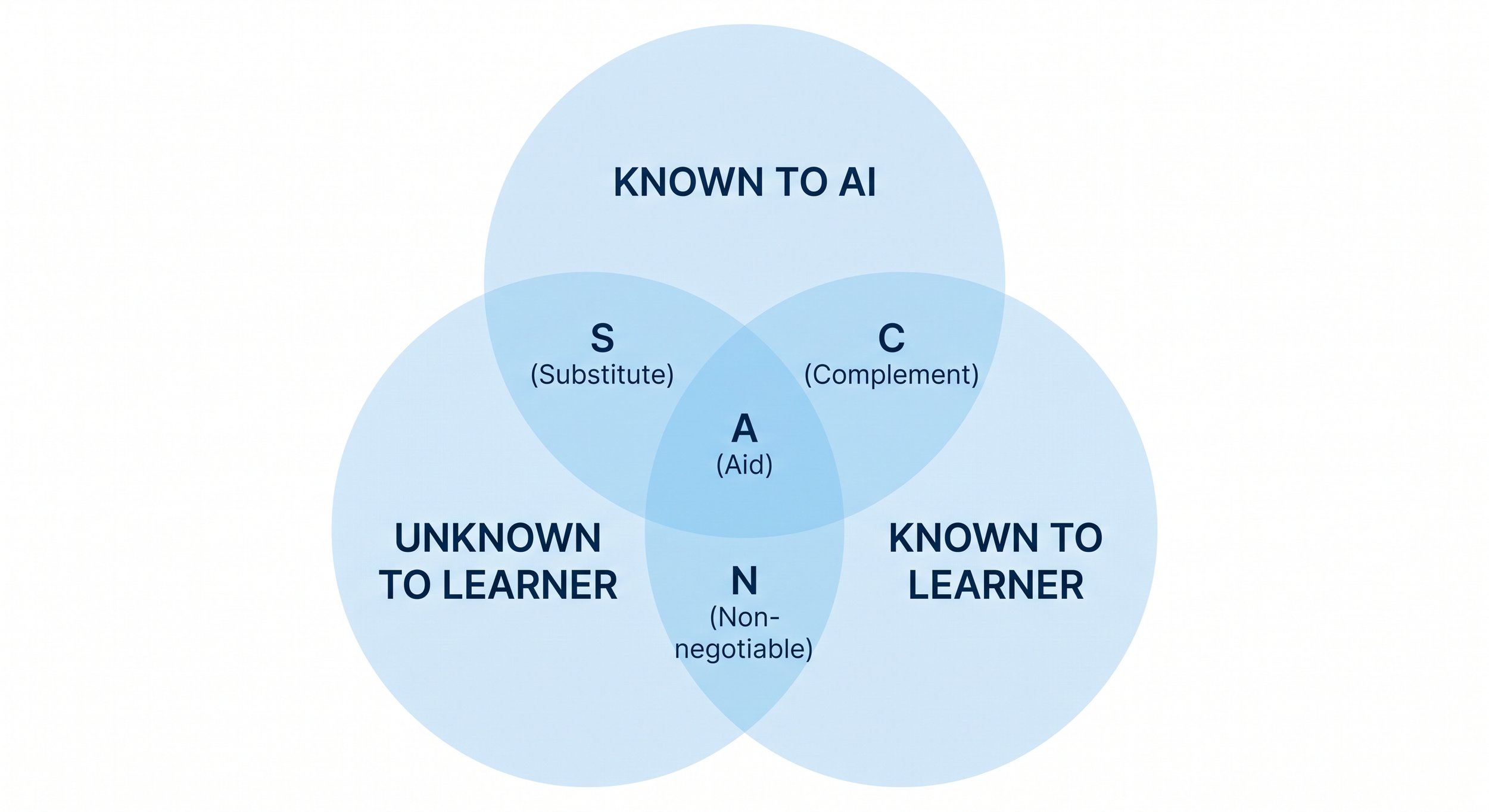
Tsim, F., & Gutoreva, A. (2026). SCAN: A Decision-Making Framework for Effective Task Allocation with Generative AI. arXiv preprint arXiv:2606.15601.
The framework maps out the relationship between what the AI knows and what the human learner knows, splitting task allocation into four modes:
Substitute (S): Tasks that are known to the AI but unknown to the human learner.
Complement (C): Tasks that are already known to both the AI and the human learner.
Aid (A): Tasks sitting at the intersection of AI knowledge and the learner's expanding capabilities.
Non-negotiable (N): Tasks completely outside the AI's domain that must remain securely with the human.
This is a handy diagnostic tool. It gives teams a structured delegation strategy that makes sure efficiency doesn’t come at the cost of the cognitive skills we still need to exercise ourselves.
—-
Tsim, F., & Gutoreva, A. (2026). SCAN: A Decision-Making Framework for Effective Task Allocation with Generative AI. arXiv preprint arXiv:2606.15601.
https://arxiv.org/abs/2606.15601
