
Framework for AI engagement in organisations
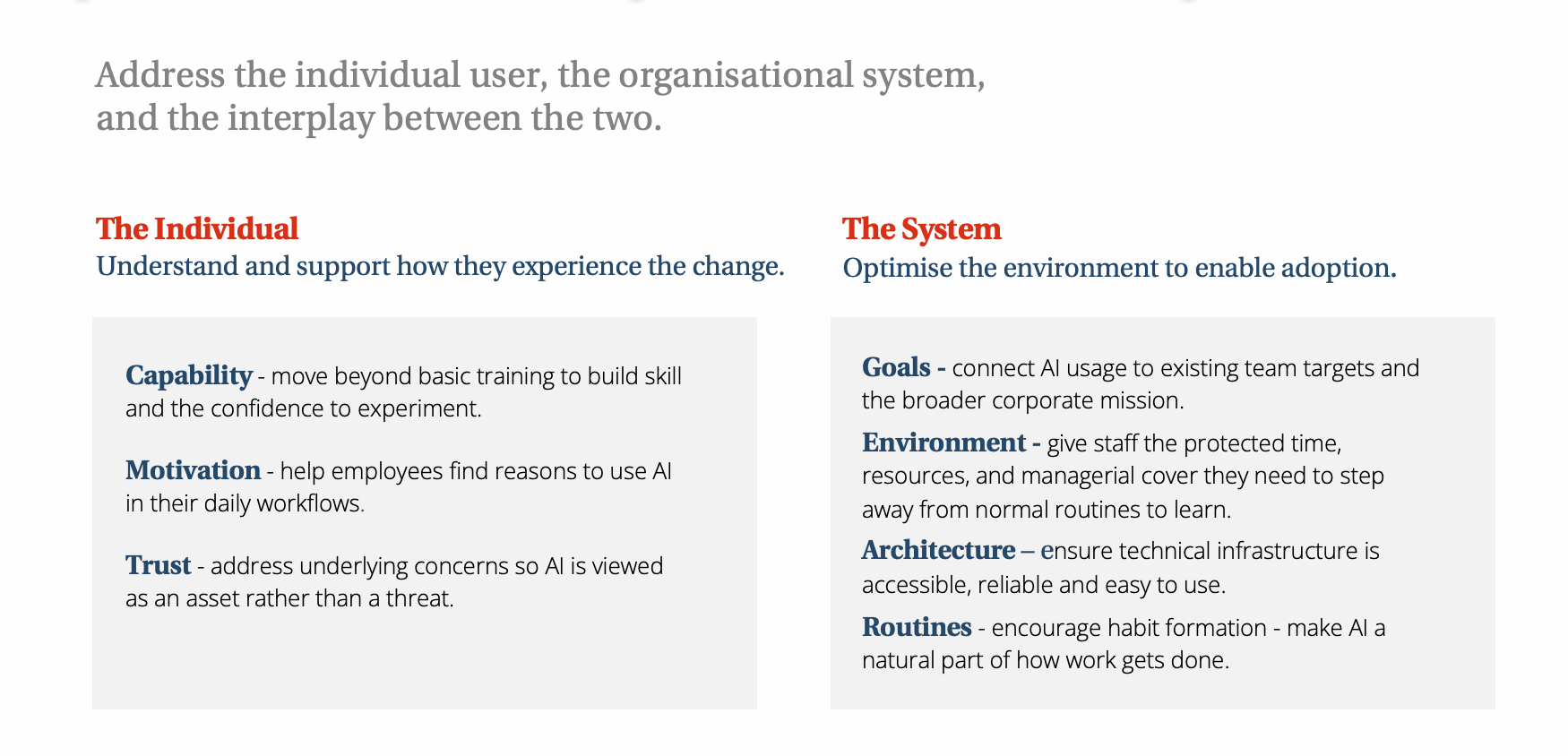
A number of academic and institutional theories feed into our framework:
The COM-B Model: Developed in 2011 by Susan Michie, Robert West, and Maartje van Stralen at University College London, this framework states that behaviour change requires three essential components: Capability, Opportunity, and Motivation. It’s commonly used all over the world as a diagnostic tool to understand why a specific behaviour occurs (or doesn't) and then used to inform the design of targeted interventions.
Further reading: Claremont: COM-B Model
The I-Frame vs. S-Frame: Detailed in a 2022 paper by Nick Chater and George Loewenstein, this theory argues that behavioural science has been too focused on fixing individual behaviour (the "i-frame") and suggests that real change requires a focus on systemic, structural interventions (the "s-frame") because individual nudges are often ineffective if the environment is broken.
Further reading: National Library of Medicine: The I-frame vs. S-frame
Crucially, true adoption can’t be achieved by looking at the individual or the system in isolation. Our approach focuses on the interplay between the two. It maps how individual psychological factors collide with, influence and are shaped by systemic realities.
The Behavioural Insights Team (BIT) AI Adoption Principles: BIT treats AI adoption as a behavioural and organisational change rather than a technical rollout. Their frameworks focus on diagnosing psychological roadblocks - such as trust, psychological safety, and motivation - and they use habit-forming models like the EAST framework (making behaviours Easy, Attractive, Social, and Timely) to encourage lasting adoption.
Further reading: BIT: Accelerate AI adoption with behavioural science
